 Follow Jan via Twitter
Aging, Globalization and Inequality
The New Critical Gerontology
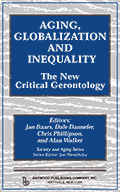
Aging, Globalization and Inequality: The New Critical Gerontology
Editors: Jan Baars, Dale Dannefer, Chris Phillipson & Alan Walker
Baywood Publishing
January 2006
ISBN: 9780895033581
Aging, Globalization and Inequality is a major reassessment of work in the field of critical gerontology, providing a comprehensive survey of issues by a team of contributors drawn from Europe and North America. The book focuses on the variety of ways in which age and aging are socially constructed, and the extent to which growing old is being transformed through processes associated with globalization. The collection offers a range of alternative views and visions about the nature of social aging, making a major contribution to theory-building within the discipline of gerontology. The different sections of the book give an overview of the key issues and concerns underlying the development of critical gerontology. These include: first, the impact of globalization and of multinational organizations and agencies on the lives of older people; second, the factors contributing to the "social construction" of later life; and third, issues associated with diversity and inequality in old age, arising through the effects of cumulative advantage and disadvantage over the life course. These different themes are analyzed using a variety of theoretical perspectives drawn from sociology, social policy, political science, and social anthropology.
Aging, Globalization and Inequality brings together key contributors to critical perspectives on aging and is unique in the range of themes and concerns covered in a single volume. The study moves forward an important area of debate in studies of aging and thus provides the basis for a new type of critical gerontology relevant to the twenty-first century.
Intended audience
Academics in the field of aging; undergraduate and postgraduate students taking courses and modules in gerontology; policymakers.
In praise of
"A stellar quartet of editors has assembled a superlative international team of authors to articulate and demonstrate how scholarship in critical gerontology has matured over the years. Among this book's stimulating themes are: the role of power in shaping age as a property of political and social systems; the impact of globalization in shifting the locus of power that affects aging, away from localities and nations to international organizations; and the inequalities attributable to cumulative life course advantages and disadvantages, social and cultural diversity, and the economic, social, and political divide between developed and developing nations. Every social gerontologist should read this book."
-- Robert H. Binstock, Ph.D., Professor of Aging, Health, and Society, Case Western Reserve University
"Four of the most accomplished and thoughtful social theorists in the field of aging edited and contributed to this book, and, joined by nine other fine thinkers, they attempt to stake out a new variant of critical gerontology. . . . The challenge is given to move beyond postmodernism and to theorize the aging experience in terms of globalization, which is examined explicitly in several of the chapters. Additional substantive chapters examine medicalization and inequality in the context of this new, critical gerontology. No serious scholar or student of social theory and aging can afford to ignore this book, as it is the most trenchant theoretical critique and theoretical statement in social gerontology to appear in many, many years."
-- Victor Marshall, Ph.D., Director, Institute of Aging, The University of North Carolina at Chapel Hill
"This volume brings together a distinguished set of international scholars whose ideas converge on a strong ontological case for age as a social construction. . . . by taking a macro-structural perspective these essays illuminate how a critical view of social aging in the era of globalization can take us beyond age-centric explanations to more satisfying theories of social differentiation and stratification, linking this social construct to broader globalizing processes that erode economic boundaries, challenge national policies, and expose individuals to risks to their well-being across the lifespan."
-- Angela M. O'Rand, Ph.D., Professor of Sociology, Duke University
About the editors
Jan Baars, Ph.D., studied sociology and philosophy in Amsterdam and is Professor of Interpretive Gerontology at the University for Humanistics in Utrecht and Professor of Philosophy of the Social Sciences and the Humanities at Tilburg University, Netherlands. He has published and (co-)edited a dozen books and published many articles on philosophical and gerontological subjects in English, German, French, Finnish, and Dutch. His main interests are theoretical and practical presuppositions in approaches to aging, especially conceptions of time and temporality. He has lectured at many universities in Europe, the United States, South Africa and Japan and chaired gerontological symposia in Australia, the United States, and Japan.
Dale Dannefer's scholarly work is concerned with the links between social dynamics and life course processes. A pioneer in developing cumulative advantage theory as an explanatory life-course framework, he has published more than 60 articles, monographs, and chapters in sociology, psychology, human development, education, and gerontology. Dannefer's current scholarship focuses on the effects of globalization on life course patterns and the problem of age segregation. He has just completed a large-scale empirical study of "culture change" in long-term care settings. He teaches courses on life course and human development, the sociology of work and education, and social theory. He has been a research fellow in the Social Control program at Yale University, at the Andrus Gerontology Center at the University of Southern California, and at the Max Planck Institute for Human Development and Education in Berlin.
Chris Phillipson is Professor of Applied Social Studies and Social Gerontology at the University of Keele, United Kingdom; he is also Pro-Vice Chancellor (Learning and Academic Development) for the University. He has published extensively in the field of critical gerontology and related areas, and is currently undertaking research on issues relating to social exclusion in old age and the impact of urbanization on the lives of older people. His books include Reconstructing Old Age; The Family and Community Life of Older People (co-authored) and Women in Transition: A Study of the Experiences of Bangladeshi Women Living in Tower Hamlets (co-authored).
Alan Walker is Professor of Social Policy at the University of Sheffield, United Kingdom, and is Director of The European Research Area in Ageing. Previously he was Director of the Economic and Social Research Council's Growing Older Programme and the European Forum on Population Ageing Research. He is co-founder and chair of the European Foundation on Social Quality. Walker was a member of the Technical Committee responsible for drafting the 2002 U.N. Plan of Action on Ageing, and he chaired the European Commission's Observatory on Ageing and Older People. He has been researching and writing on aging, social policy, and related issues for nearly 30 years and has published more than 20 books and 300 scientific papers. Recent books include The New Generational Contract; Ageing Europe; Combating Age Barriers in Employment; The Politics of Old Age in Europe; and Growing Older: Quality of Life in Old Age.
Jan Baars, Ph. D. --- info@janbaars.nl

 Download the first chapter of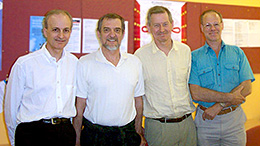
 Aging, Globalization & Inequality: The New Critical Gerontology